

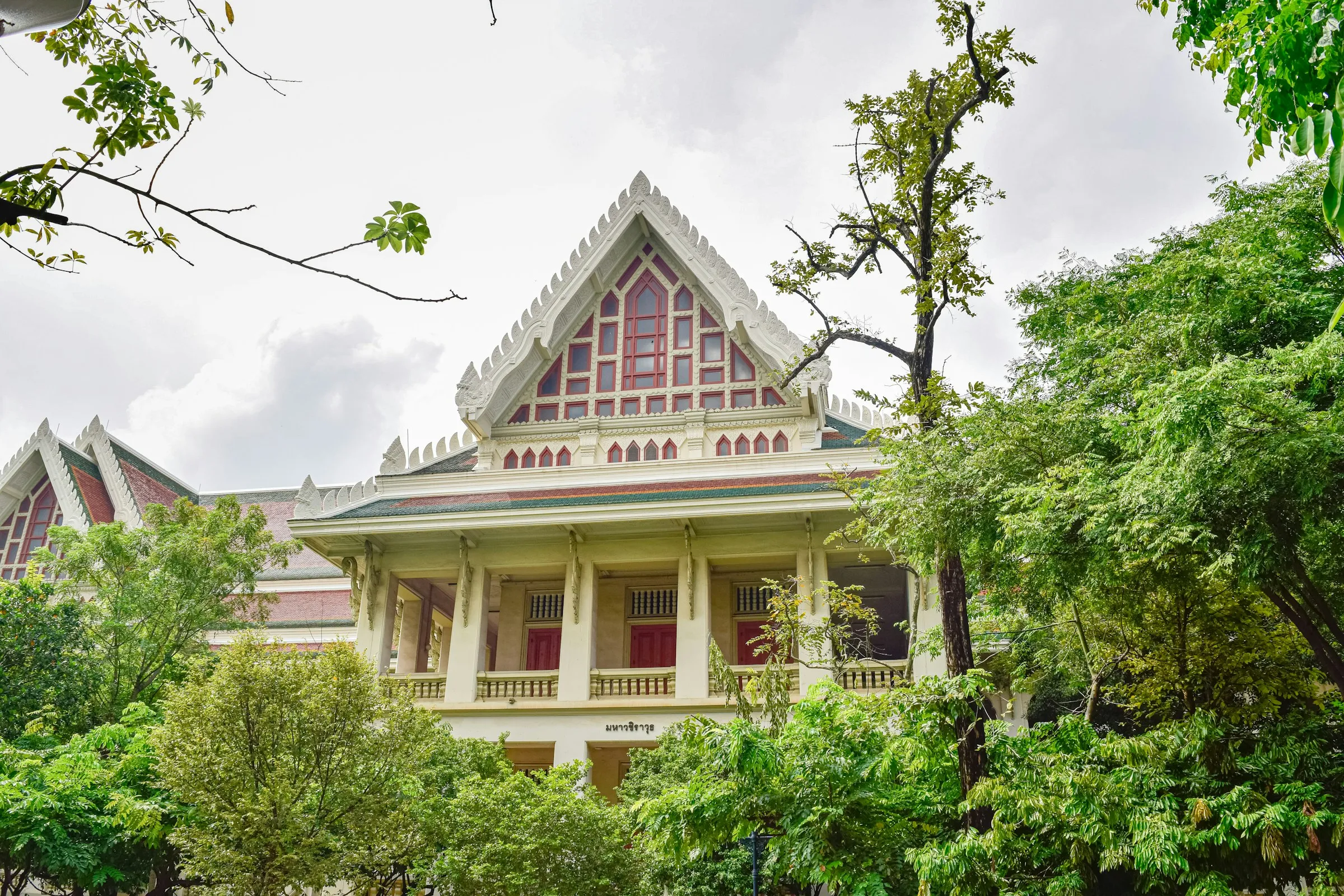
1. Asian Institute of Technology (AIT)
Known across Asia as an international postgraduate hub, AIT offers a fully global environment (English-medium) with strong research programs in Engineering, Environment, Remote Sensing, and Management.
- Address: 58 Moo 9, Paholyothin Highway, Km. 42, Klong Luang, Pathum Thani 12120, Thailand
- Email: admissions@ait.ac.th / oia@ait.ac.th
2. Chulalongkorn University (CU)
As Thailand's oldest and top-ranked institution, Chulalongkorn offers prestigious international undergraduate and postgraduate programs (CU-INDA, ISE, BSBA) in Business, Engineering, and Social Sciences.
- Address: 254 Phayathai Road, Pathumwan, Bangkok 10330, Thailand
- Email: int.off@chula.ac.th
3. Mahidol University (MU)
Consistently ranked among the top universities in Thailand, Mahidol is world-renowned for Medicine, Public Health, Life Sciences, and offers a dedicated International College (MUIC) for Arts, Science, and Business.
- Address: 999 Phutthamonthon 4 Road, Salaya, Nakhon Pathom 73170, Thailand
- Email: msinteradmission@mahidol.ac.th / opinter@mahidol.ac.th
4. Thammasat University (TU)
A leading public research university famous for Economics, Law, Political Science, and Business (MIM, TEP/TEPE Engineering), attracting international students from across South and Southeast Asia.
- Address: 2 Prachan Road, Phra Barom Maha Ratchawang, Phra Nakhon, Bangkok 10200, Thailand
- Email: oia@tu.ac.th / iad@tu.ac.th
5. Kasetsart University (KU)
One of Thailand's largest universities, highly preferred for Agricultural Sciences, Forestry, Environmental Engineering, Biotechnology, and International Business (KUIC).
- Address: 50 Ngamwongwan Road, Lat Yao, Chatuchak, Bangkok 10900, Thailand
- Email: kuic@ku.th / iad@ku.th
A. Key Advantages for Students
- Western Dual Degrees & Twinning Programs: Top Thai institutions partner with renowned UK, US, and Australian universities (e.g., Webster University, Stamford International University), enabling students to obtain globally recognized Western degrees at a fraction of Western tuition costs.
- Proximity & Affordable Quality Education: Proximity to Bangladesh means low travel expenses, easy cultural transition, and access to top-ranked Asian universities (such as Chulalongkorn, Mahidol, and AIT).
- High Visa Success Rate: Transparent visa processing via the Royal Thai Embassy with straightforward document requirements and minimal bureaucratic delays.
- Warm, Safe, and Multicultural Environment: Thailand is widely celebrated for its hospitality, safety, excellent healthcare infrastructure, and accessible Halal dining options across major metropolitan areas like Bangkok.
- Part-Time Work Allowances: While student visas strictly emphasize full-time study, students can participate in university assistantships (TA/RA), paid internships, or seasonal work arrangements.
B. Famous Universities & In-Demand Programs
- Top Public & Autonomous Universities: Asian Institute of Technology (AIT), Chulalongkorn University, Mahidol University, Thammasat University, and Kasetsart University.
- Top Private & International Universities: Assumption University (AU / ABAC), Stamford International University, Bangkok University International (BUI), and Webster University Thailand.
- Potential Subjects:
- Engineering, IT & Innovation: Computer Science, AI, Data Science, Software Engineering, Civil & Environmental Engineering.
- Business & Hospitality: International Business, Hotel & Tourism Management, Supply Chain Management, Global MBA.
- Life Sciences & Health: Public Health, Biotechnology, Biomedical Sciences, Nursing.
- Development Studies: Sustainable Development, Gender Studies, International Relations.
C. Total Investment & Self-Funded Budgets
- 3 to 4-Year Graduation (Bachelor’s): Self-funded students require a total estimated budget of $12,000 to $22,000 USD (approx. THB 420,000 to 770,000), covering 3–4 years of tuition and living expenses.
- 1.5 to 2-Year Master’s Degree: Total estimated budget ranges between $6,000 and $12,000 USD (Note: Fully and partially funded scholarships, such as AIT Fellowships and Royal Thai Government Scholarships, are widely available for South Asian applicants).
D. Living Cost Breakdown
- Official Annual Living Expense: $2,500 to $4,200 USD per year (~$200 to $350 USD per month / THB 7,000 to 12,000 per month).
- Monthly Expense Breakdown:
- Accommodation (Student Condo / Shared Apartment): $100 – $180 / month (THB 3,500 – 6,500)
- Food & Dining: $90 – $140 / month (THB 3,000 – 5,000)
- Transport & Utilities: $25 – $45 / month (THB 900 – 1,600)
E. IELTS & Entry Requirements
- Standard IELTS: Regular admission typically requires an IELTS score between 5.0 and 6.0 for Bachelor’s programs and 6.0 to 6.5 for Master’s programs.
- Internal English Preparation: Most international universities offer Intensive English Language Programs (IELP) prior to degree commencement for conditional admittees.
- MOI & Internal Tests: Medium of Instruction (MOI) certificates from recognized Bangladeshi institutions or university-specific internal English evaluations are widely accepted across Thai international programs.
Opportunity for University Admission without IELTS
Although multiple international destinations offer alternative admission pathways in lieu of IELTS, these provisions are not standardized globally and vary depending on national regulations and institutional policies.
Key Requirements to Get an IELTS Waiver
When a university in Thailand waives IELTS, they usually require one or more of the following credentials:
- Medium of Instruction (MOI) Certificate: An official letter from your previous college or university confirming that your degree program was taught and assessed entirely in English.
- High Secondary School English Marks: Strong grades in English (typically 65%–80% or above) on your Higher Secondary Certificate (HSC), A-Levels, or equivalent national exams.
- Internal University Assessment: Passing an online internal test, a password exam, or a viva/interview conducted directly by the university's admissions team.
- Alternative English Proficiency Tests: Submitting scores from faster, online-friendly platforms such as the Duolingo English Test (DET), Oxford ELLT, or PTE Academic.
Online English Test by the University
An Internal Online English Test conducted by a university is a recognized alternative to traditional standardized exams like IELTS, TOEFL, or PTE. It allows international applicants to demonstrate their English language proficiency directly through the institution's admissions system.
How University Online English Tests Work
Instead of registering with a third-party testing agency, candidates take an assessment designed, managed, or approved by the university itself.
- Testing Format: Tests are usually computer-based and assess the four core skills: Listening, Reading, Writing, and Speaking.
- Delivery: Administered securely online through the university's portal or partner platforms (e.g., Oxford ELLT, Password Skills Test, or internal Zoom/Teams sessions).
- Proctoring: Monitored live by a human examiner or through AI-driven proctoring software (screen sharing, webcam recording, 360° room scan) to ensure academic integrity.
Key Components of the Assessment
A university’s internal online English assessment evaluates an applicant’s language proficiency across four fundamental components: Reading, Listening, Writing, and Speaking.
The evaluation begins with the Reading Comprehension module, which tests the candidate’s ability to analyze written academic text, understand main ideas, and grasp complex sentence structures and vocabulary. Complementing this is the Listening component, where applicants listen to audio recordings of academic lectures and everyday campus conversations, answering questions to demonstrate their oral comprehension and ability to follow spoken English in real-time.
The assessment then transitions to Writing, requiring candidates to produce short essays or structured responses. This section measures grammar, vocabulary range, logical organization, and overall written expression. Finally, the test concludes with a live Speaking section—conducted as a virtual interview or viva voce with an examiner—to assess verbal fluency, pronunciation, and the applicant's ability to communicate naturally in an academic setting.
- Written & Receptive Skills (Automated or Timed):
- Reading & Grammar: Multiple-choice questions testing passage comprehension, vocabulary, and sentence structure.
- Listening: Short audio recordings, academic discussions, or lectures followed by comprehension questions.
- Writing: An online essay (typically 250–400 words) or short-answer prompt to evaluate clarity, coherence, and grammar.
- Speaking Skills (Live Evaluation):
- A 15-to-20-minute video interaction with a university instructor or examiner.
- Includes a self-introduction, discussion on general/academic topics, and questions expanding on your written essay submission.